“Christ loved the church and gave himself up for her, in order to make her holy by cleansing her with the washing of water by the word.” (Ephesians 5:25-26).
Years ago when the remains of Fr. Kapuan, the former army chaplain and Kansas native son, were moved to the Catholic cathedral in Wichita, people lined the streets to see him come home. At a backyard birthday party, I learned that a friend’s father was there. “Tell me about why it was important for you to be there,” I said. He mulled it over. “I think it’s because it’s probably the closest I’ll ever come to a saint.”
But what if we are closer to the saints than we realize? God calls all his people to holiness. What if some of them respond right here, right now, in our local church?
The Nicene Creed confesses that the church is holy. More often than not, that declaration feels more aspirational than actual. We’re hardly holy. Half the time, we’re not even all that interested in holiness.
And yet, sometimes we encounter holy men and women among us, the saints in the back row who quietly enfold us in their prayers. Maybe there are more of them than we know. Maybe even behind every thriving church, there’s a saint.
In the New Testament, the word “saint” speaks of God’s holy ones. Saints are set apart by God, but in its most basic sense, saints are not a special class of Christian. They’re God’s people—all those who are growing up into the image of Christ. This is why when the apostle Paul addresses the churches in his letters, he refers to them as “saints.” He writes to the Romans: “to all God’s beloved in Rome, who are called to be saints” (1:7). He writes to the Corinthians: “to the church of God that is in Corinth, to those who are sanctified in Christ Jesus, called to be saints” (1 Cor. 1:2). He writes “to the saints in Ephesus,” “to all the saints in Christ Jesus who are in Philippi,” “to the saints and faithful brothers and sisters in Christ in Colossae” (Ephesians 1:1-2; Philippians 1:1; Colossians 1:2). And so on. God’s people are the saints, and it’s not because they have succeeded in their own efforts to live holy lives, but because by cooperating with God’s grace they have begun to grow into holiness.
Paul wrote to the Ephesians that out of Christ’s great love for the church he gave himself up for her through his death on the cross to make “her holy by cleansing her with the washing of water by the word” (Ephesians 5:25-26). Christ makes that holiness available to all his people, but there are some who drink more deeply from the well than others.
This is why from ancient times the church has also spoken of capital “S” Saints—those who were particularly adept at cooperating with God’s grace. They’re men and women who put their hands to the plow and did not turn back, who followed the pioneer and perfecter of their faith come what may, who found their anchor in God their refuge and strength. They’re the Benedicts and Augustines and Wenceslauses and Teresas of Lisieux–people whose lives grew toward Christ in a unique way, in whom God planted a special grace.
We need saints like that in our lives. It is good to surround ourselves with those who hunger and thirst for righteousness and grow daily in the “holiness without which no one will see God” (Matthew 5:6; Hebrews 12:14). They remind us that, by God’s grace, the Christian life of holiness is possible, and they speak with a wisdom that comes from above.
I’ve met a few of these saints. They’re demure, almost to the point of shy. They’re hopeful. As a rule, they won’t tell you they’re a saint. They do quiet, loving things with their lives and with their prayers. One man I know visits incarcerated people and invests his early mornings in prayer. He makes a point of encouraging others. He’s the kind person who reveals a little more of Christ’s “greater things” in the world (John 14:12). When I meet folks like this, I think: I want what they’ve got.
I’ve read a few saints too. In fact, a couple of years ago, when one of my tradition’s greatest thinkers toppled off his pedestal, I decided that I didn’t want to read any theology that wasn’t written by a saint. Sure, all of us sin and fall short of the glory of God. But I longed for more and deeper and holier. I decided to only read saints. (Nevermind that if others followed my rule, they wouldn’t read me). I’ve stuck to my resolution in fits and starts, but I think the intuition at least is correct: we need to hear from people who are in touch with God’s holy character. I want a little of the fire of their words to jump over to my heart too.
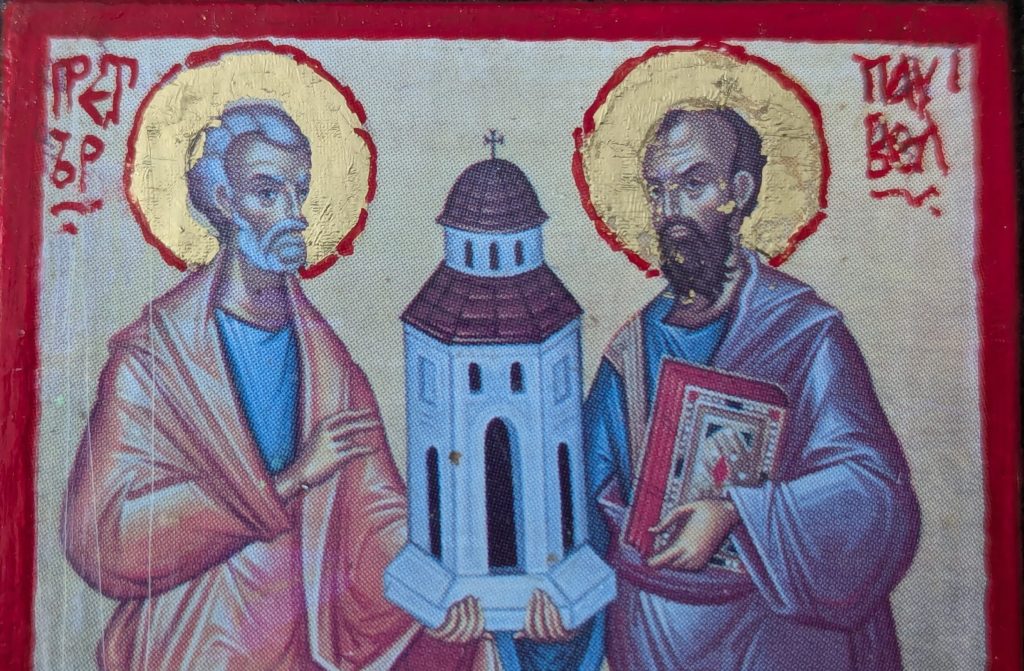
Long ago, I worked in a library. In a display case on the upper floor, there was an ancient statue of a saint cradling a church in her hands. I was a good Mennonite boy, so I didn’t know anything about it. I didn’t know what saint or what church. But the statue fascinated me, and I discovered that in antiquity this was often how patron saints were depicted. Carving the saint with a church in his or her hands was a way of communicating that the saint loved that church. The saint holds that church up before God in prayer. That saint was hugging her church.
We need these saints around us—the ones who hug the church. They point us toward the life of holiness. They speak and write from God’s heart.
I bet you know more saints like this than you realize. Keep them close!

 The Doxology Project
Leave a comment