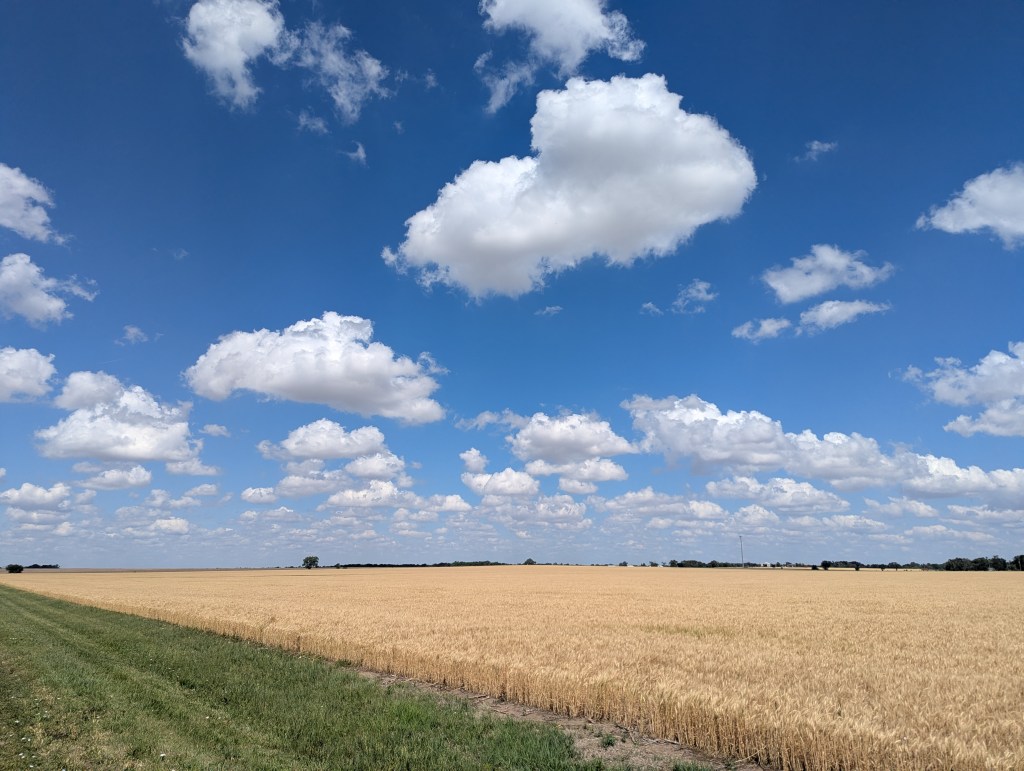
I love the Kansas sky. There’s just so much of it, especially out west—the tented blue, wide with its own emptiness but for the scuff of a distant plane contrail. I’m not the only one. A relative came to stay with us, and everywhere we go, she pulls out her phone for a pic. Look at those clouds, that horizon, that sunset!
Part of thriving in rural ministry is learning to see the goodness of rural places, their physical and moral beauty. If we’re present and open, Jesus will transfigure our vision. We’ll begin to see through what Thomas Merton called in his journals the “angelic transparency of everything” to recognize Jesus’ presence and work.
At the transfiguration on Mt. Tabor, accompanied only by the Brothers Zebedee, Peter blurts out: “Lord, it is good for us to be here” (Matthew 17:4). It’s the moment when Peter either wakes up or loses his mind—the church fathers are split—and sees the beauty and goodness of place. Some ancient commentators, following the Gospel of Mark, highlight how Peter “did not know what to say” and thus babbled nonsense (Mark 9:6). Proclus of Constantinople sermonized, “How can it be ‘good for us to be here,’ where the snake deceived and injured the first humans created, and shut Paradise? Where we have heard that we must eat our bread ‘in the sweat of our face’?” (Brian E. Daley, trans., Light on the Mountain, Popular Patristics Series). Move along to the cross and the resurrection, Peter. No goodness to speak of here.
Yet other ancient preachers saw in Peter’s words a recognition of the goodness of that moment and the place itself. Peter may not have known what to say, but he saw clearly—into the joy of the really Real of Jesus’ identity. “Galilee and Nazareth dance today, and begin a rural celebration,” preached Anastasius of Sinai in the seventh century. In an echo of Jacob’s discovery in Genesis 28:16, Peter’s eyes were opened by Jesus to the goodness of being in that place.
We too can ask for God’s grace to open our eyes to the physical and moral beauty of rural places.
Rural places are physically beautiful if we can learn how to see them. I don’t just mean the rural Rockies, the rural rugged Pacific Northwest coastline, the rural cactus-armed deserts of the Southwest. I mean the oft-flown-over places that the USDA coded headache orange in their Natural Amenities Index. The Plains and Midwest scrape rock bottom of that scale. Apparently, for most of my life I’ve been slumming it with crummy natural amenities. I realize that not everybody has the same appreciation for the Kansas landscape. Blue and blue and piles of clouds flat-ironed over plains of wheat are not everybody’s cup of tea (though maybe they should be). But it seems to me that writing off an entire swath of the earth as undesirable is a failure of imagination. It might even be a sin against what God has made.
On the other hand, to truly see, to be present and open, is meditation. It’s an act of prayer. In fact, Peter’s utterance: “Lord, it is good for us to be here” is almost an arrow prayer, that kind of short prayer said repeatedly that was developed in the eastern desert tradition. Probably the most well-known arrow prayer is the Jesus Prayer: “Lord Jesus Christ, Son of God, have mercy on me, a sinner.” Breathe Peter’s arrow prayer a couple of fifty times a day and see what happens to your view of your rural place. Maybe you’ll find yourself growing in the awareness of the physical beauty with which God has subtly gilded every place.
Rural places are morally beautiful. In some circles, that simple claim is suspect. For a lot of years, the ambient message has been that rural communities are drying up and falling apart, awash with opioids and racist ideology and prone to make poor voting choices. Sure, you can always go find an example of the reality you’re looking for. But in my experience, rural communities are marked by moral beauty. They’re neighborly places, places where (for better or worse), everybody knows your name. Urban and suburban communities have pockets of this too. There are grace notes everywhere. But rural communities find their identity in neighborliness rooted in place. It’s unique and defining.
When a little girl was diagnosed with an incurable brain tumor in my rural Kansas town, the whole community activated to raise funds to support the family. A benefit auction was massively donated toward and attended. When sadly the tumor took her life later in the year, the whole community again turned out for her funeral, which was held in the school gymnasium. Now, the town is upgrading a play area in the park with funds donated in her honor.
This is the kind of thing I hear about whenever I talk to rural leaders. It’s what rural looks like. This is what we do. But you wouldn’t catch this view of rural if you only tuned into the broad stroke national discourse around rural decline that crops up around every presidential election cycle. We need the grace to see the moral beauty of rural.
Of course, just as Peter recognized, it is good to be here—to be anywhere—because Jesus is present and at work. The goodness of a place derives from and is drawn into His great goodness. Beauty happens where heaven elides with earth.
I’m convinced that Jesus continues to be present and at work in rural places—just as he was on Mt. Tabor.
Lord, it is good for us to be here!
This post originally appeared on the Town Square Collaborative Substack.
Learn more about the work of the Town Square Collaborative.


Leave a Reply