I once drove an elderly relative into the city. “Wouldn’t you like to be pastor at a big church downtown?” they said. I think they meant it as a pinch for me to try harder, work my way up to some bigger pulpit. I shrugged—my get-thee-behind-me-Satan moment in a minivan. Those big churches downtown are just fine. But I love being a part of all the good that’s happening in the rural church.
Rural can mean many things to people: an idyll, a backwater to get stuck in, a second-class kind of place, disappointing when compared to the big, paved, downtown.
But I’m convinced rural is a place of possibility, and I want to give thanks for it.
Two guides can help us see and cherish the possibilities of rural. Both were contemplative farmers who lived and wrote from the hills of Kentucky: Wendell Berry and Thomas Merton.
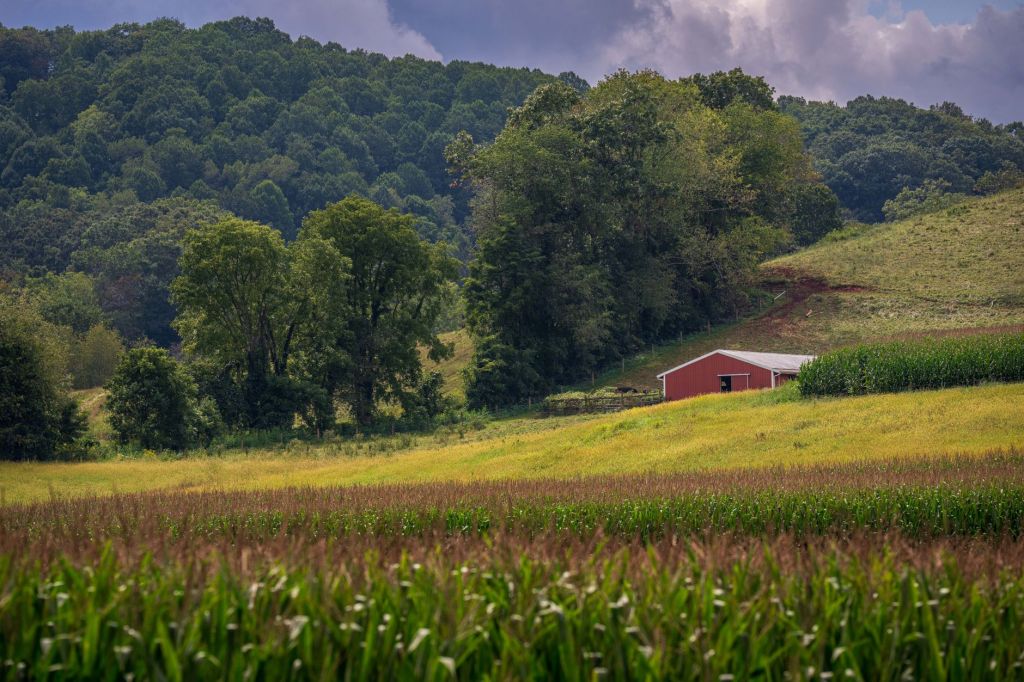
In his 1980 essay “The Making of a Marginal Farm,” Wendell Berry writes about gazing out over the valley where he had grown up: “a green trough full of sunlight, blue in its distances” and declaring “That’s all I need.” He says it was “my recognition of its beauty, the abundance of its lives and possibilities” (in The World-Ending Fire, p.38). Berry would continue living many more years away from that valley—in New York City, Stanford, and Italy, before finding his way back to teach writing at Lexington, Kentucky. He and his wife would go on to buy family land nestled amongst the hills—his affectionately termed “marginal farm.”
Berry and clan set themselves to restoring that place, gradually expanding the farm and coming to rely on it for food and fuel while he taught at the University of Kentucky. “My ‘subject matter’ would be, as it had been, the few square miles in Henry County where I grew up” (p.39).
Berry’s story is one of returning to rural after urban education and experience. That boomerang is probably essential to making him who he was. Can you learn to write like Berry did without sitting under Wallace Stegner at Stanford? But his life also becomes a parable of rural’s possibilities. Berry would have been a much less interesting writer had he not been working the steep hillsides of his rural homestead with a team of mules.
Incredibly, while Berry pecked some of the greatest rural environmentalist writing of our age on his typewriter, Thomas Merton sat at another typewriter in those same Kentucky hills. At one point, Berry and Merton even met. (Wouldn’t you have liked to have been in that grainy black and white photo?)
Merton’s life followed a similar, if more chaotic arc to Berry’s. He banged around the east coast of the US, Bermuda, and Britain before converting to Catholicism and becoming a Trappist monk. In his early days at the monastery, Merton worked the land alongside the other novices. He once playfully introduced himself as “A farmer from Nelson County.” Although he did agricultural work, Merton came to focus his life on prayer and writing. In a journal entry, he said “I am a writer…for me to write is to think and to live and also, in some degree, even to pray” (Sept. 27, 1958, III.219).
Berry and Merton were both men who discovered the possibility of their greatness and genius in rural. They came to rural or returned to rural, but were also products of rural. Berry couldn’t have made the impact he did without his marginal farm and team of mules. Merton couldn’t have delved the soul without the night quiet of his hermitage. The peace of their places shaped them, which is why at various points, both of them spoke of their annoyance at the gruntful intrusions of bulldozers in their valleys.
So this: there are Berrys and Mertons yet today, inhabiting rural places as neighbors. There are those who, far from being limited by their rural locale or pining for the downtown, are discovering rural as a generous space where real human life can be lived, for the life of the world. Rural people share all these potentialities because God has made them and made them there. Whatever rural’s hardnesses in our contemporary age, don’t forget its possibilities: the deep soil of its stories, the bonds of its community, the resilience of its people, the surprising joy of life at the human scale. There are native sons and daughters of rural, as well as newcomers to its hills and plains, who are right now writing and tilling and brewing and praying a world into being that is truer than the fast pavement we lay over it.
Give thanks for the possibility of rural!
This post originally appeared on the Town Square Collaborative Substack.
Learn more about the work of the Town Square Collaborative.


Leave a Reply